


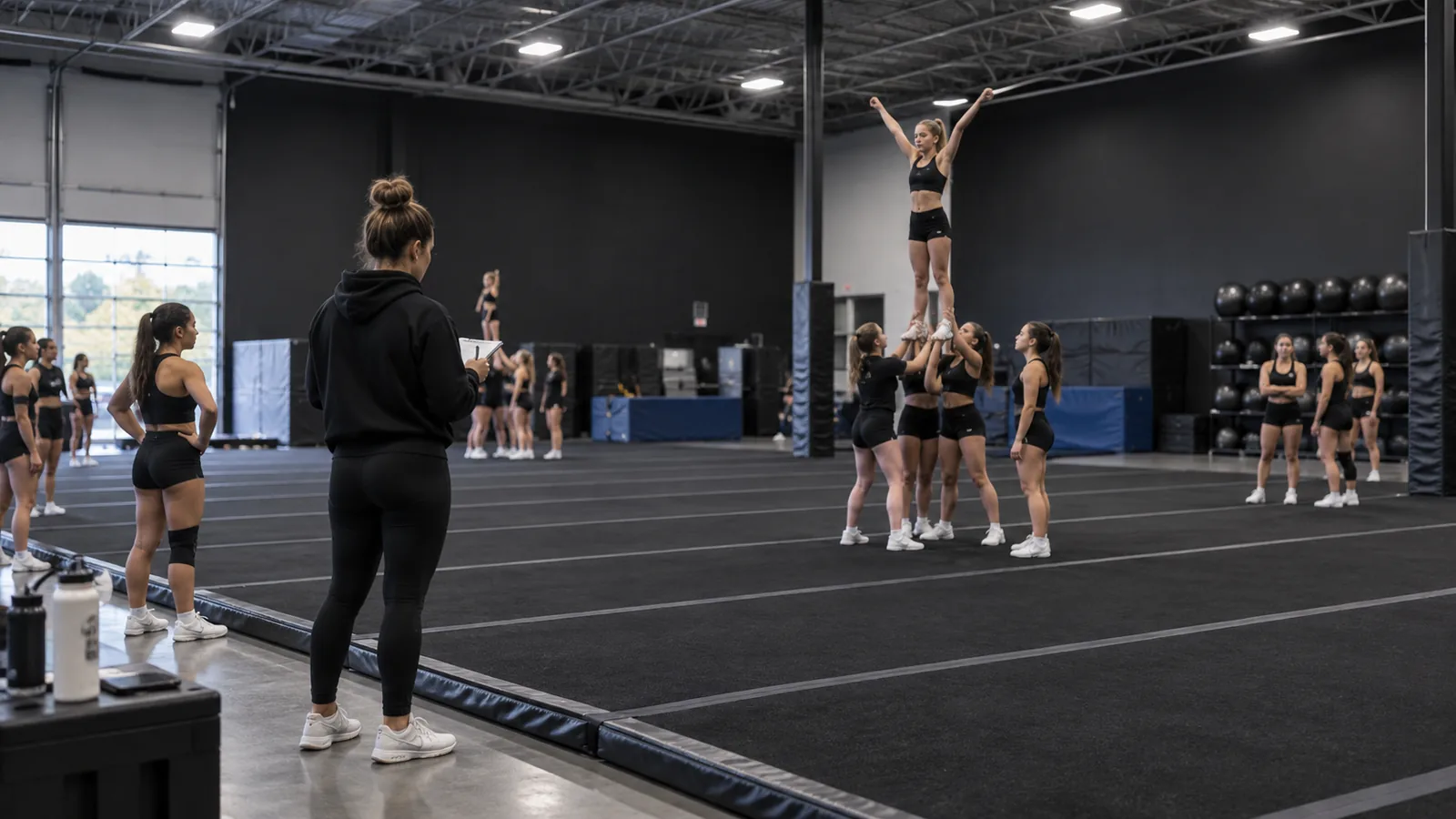
By December, most competitive cheer teams know much more about their routine than they did at the beginning of the season.
You have seen it in practice. You may have performed it at showcases or early competitions. You have a better sense of which sections are dependable, which ones need work, and where athletes are gaining confidence.
That often leads to an important question:
Should we upgrade before January?
For some teams, adding difficulty makes sense. For others, the better decision is to keep cleaning the routine they already have.
The key is not making an upgrade because another team has one, because a skill finally hit once in practice, or because January feels like a deadline.
The decision should come from consistency, scoring feedback, available training time, risk, and what your current routine still has left to improve.
Scoring systems vary between organizations and events, so always evaluate upgrades using the criteria your team actually competes under. But the following framework can help coaches make a more intentional decision.
Start With the Routine You Already Have
Before asking whether athletes are ready for more difficulty, ask:
How consistently are we performing what is already in the routine?
Look at more than whether the major skills “hit.”
- Stunt consistency
- Tumbling execution
- Timing and synchronization
- Formations
- Transitions
- Technique
- Performance quality
- Athlete confidence
If several of those areas are still inconsistent, adding difficulty may simply add another problem to solve.
For example, suppose a stunt group can perform a harder variation in isolated practice, but the group still struggles with the current sequence after tumbling or late in a full routine.
The upgrade may be possible.
That does not necessarily mean it is ready.
Judge Consistency by the Typical Rep, Not the Best Rep
One of the easiest mistakes coaches can make is remembering the team’s best practice rep instead of evaluating its normal one.
You know the rep.
Everything hits. Timing looks sharp. Athletes perform confidently. The entire section looks exactly how you imagined it.
That rep proves the team is capable of performing the section.
It does not prove the team can repeat it.
Track several reps instead.
Rep 1
Hit, but timing was uneven.
Rep 2
One group bobbled.
Rep 3
Clean.
Rep 4–5
One miss and one hit with visible adjustments.
That gives you more useful information than simply saying, “They can do it.”
An upgrade becomes more attractive when the current version is not only possible, but dependable.
Ask Whether the Upgrade Has a Clear Purpose
Not every harder skill creates the same value.
Before spending practice time on an upgrade, ask what problem you are trying to solve.
- Is there a specific opportunity identified through your scoring system?
- Has competition feedback consistently pointed toward this area?
- Is the current section already strong enough that additional difficulty makes sense?
- Or does the new skill simply look impressive?
A clear purpose keeps coaches from chasing difficulty without knowing what they expect it to accomplish.
If you are looking at early competition feedback and are unsure whether difficulty is actually the issue, B leJit’s Score Audit / Score Sheet Review can provide another perspective on a completed performance and the scoring information that came with it.
Learn More About Score Audit / Score Sheet Review →
Make Sure You Have Enough Time to Train the Upgrade
An upgrade is not finished when athletes first hit it.
It needs to move through several stages.
Athletes understand the new skill, counts, responsibilities, and technique.
They can perform it repeatedly during isolated practice.
The skill works inside the routine with the correct entry, exit, transition, and choreography.
Athletes can perform it during full routines and while tired.
The upgrade no longer feels new. It feels like part of the routine.
When evaluating your timeline, count actual quality practices before the next important competition.
Do not just count weeks.
Holidays, athlete absences, travel, or shortened practices may reduce your usable training time significantly.
Follow the Upgrade Through the Entire Routine
A new skill rarely affects only that skill.
Suppose you change a stunt.
Entry
Does the setup or entry need to change?
Finish
Does the new finish change where athletes are positioned?
Transition
Does someone now have farther to travel into the next formation?
Confidence
Does the change affect athlete confidence elsewhere in the routine?
Think downstream.
Sometimes a difficult skill works perfectly in isolation but creates problems when connected to everything around it.
The strongest upgrade is not simply one athletes can perform.
It is one they can integrate without destabilizing the rest of the routine.
Evaluate the Risk, Not Just the Potential Reward
Every routine decision carries tradeoffs.
When you add difficulty, ask what becomes more vulnerable.
- Could technique become less consistent?
- Could timing separate between stunt groups?
- Could athletes become hesitant?
- Could the transition become rushed?
- Could the new version take so much practice time that another section stops receiving attention?
This does not mean coaches should avoid upgrades.
It means difficulty should be evaluated alongside execution and repeatability.
Ask:
“If we add this, what new problem might we create?”
If you can identify that risk before making the change, you can decide whether you have enough time and training capacity to manage it.
Make Sure You Have Maximized the Current Routine First
Sometimes coaches search for new difficulty while useful improvements are still sitting inside the routine they already have.
Before rebuilding a section, examine these five areas.
Are body positions controlled? Are athletes finishing movements without unnecessary adjustments?
Are stunt groups, tumbling passes, and choreography finishing together?
Does energy and commitment continue between major skills?
Are landmarks clear and spacing consistent?
Are pathways efficient and repeatable?
An improvement in one of these areas may strengthen the routine without changing the difficulty at all.
Do Not Confuse a Cleaning Problem With a Difficulty Problem
Imagine your stunt section feels underwhelming.
The immediate reaction might be:
“We need something harder.”
But when you watch the section closely, you notice something else.
- The stunt groups are not hitting the body positions at the same time.
- One group finishes earlier.
- Athletes drop their performance during the transition.
- The next formation takes several counts to settle.
The problem may not be the stunt difficulty.
It may be the presentation of the section as a whole.
Cleaning the timing, transition, and finish may be a better first step than rebuilding the skill.
Use a Five-Question Upgrade Test
Before making a December routine upgrade, ask these five questions.
Can athletes reliably perform the current version in full routines?
Can you clearly explain why the upgrade is being considered?
Do scoresheets, video, and coaching observations support the change?
What will change in technique, transitions, formations, timing, or confidence?
Can athletes learn, integrate, clean, and repeat the new version before competition?
A “no” to one question does not automatically eliminate the upgrade.
It tells you where more evaluation is needed.
Upgrade Decision Checklist
Before changing the routine, check:
When You Know a Change Is Needed but Need Help Building It
Sometimes the evaluation is straightforward: the current section does need adjustment.
The harder part is deciding what the new version should look like and how to integrate it without creating additional issues elsewhere in the routine.
If you have identified a section that needs choreography or routine changes, B leJit’s Virtual Enhancement Session provides live virtual coaching that can include choreography and routine improvement work.
The Best Upgrade Is the One Your Team Can Actually Perform
December can feel like the moment when everything needs to become harder before the next phase of competition season.
It does not.
A smart upgrade can absolutely improve a routine when the timing is right.
But the decision should come from evidence.
- Look at your current consistency.
- Study your scoresheet.
- Watch competition video.
- Evaluate execution, timing, formations, transitions, and performance.
- Think about the time available.
- Ask whether added difficulty actually solves the problem in front of you.
Sometimes the right move is to upgrade.
Sometimes it is to clean.
And sometimes the strongest coaching decision is trusting the routine you already have and giving athletes the time to perform it better.