


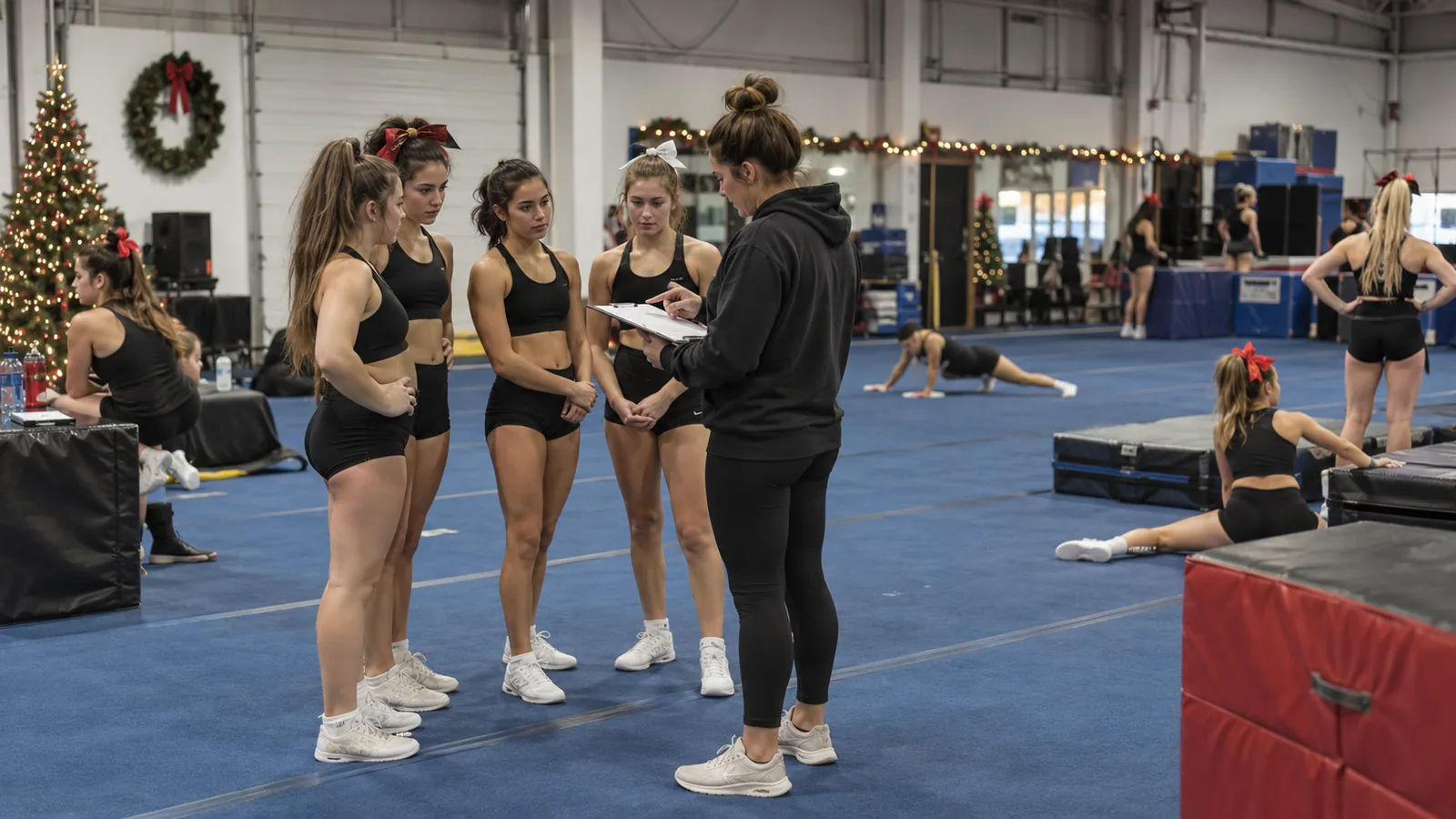
Holiday break can make cheer coaches nervous.
After months of building timing, conditioning, routine consistency, and athlete confidence, practices suddenly become less frequent—or stop completely. Athletes travel. Family schedules take priority. Gym availability changes.
It is easy to feel like the team is about to lose everything it worked to build.
But holiday break does not have to become a setback.
The goal is not to recreate normal practice at home. It is to maintain useful habits, give athletes reasonable expectations, allow them to recover, and have a clear plan for the first practices back.
Handled well, the break can become a reset instead of an interruption.
Decide What Actually Needs to Be Maintained
Before assigning holiday work, identify what matters most.
Trying to maintain every part of a competitive cheer program away from the gym is unrealistic. Athletes may not have access to a spring floor, stunt group, spotting equipment, or enough space to safely perform their normal skills.
Instead, decide which qualities athletes can reasonably maintain on their own.
- Flexibility
- General conditioning
- Core strength
- Jump technique drills
- Flyer body-position work
- Basic mobility
- Familiar, coach-approved tumbling drills that are safe for the athlete’s available environment
The important word is maintenance.
Holiday break is not the time to ask athletes to teach themselves new tumbling skills or attempt stunts without appropriate coaching, equipment, and supervision.
Give them work they already understand and can perform safely.
Give Athletes the Plan Before the Break Starts
Do not wait until everyone leaves town and then send a long list of assignments.
Review expectations during the final practices before break.
What
What exactly are athletes expected to complete?
How Often
How many maintenance sessions should they complete?
How Long
Give athletes a realistic time expectation for each session.
What Not to Do
Be clear about skills or activities athletes should not attempt on their own.
Also let athletes know whether anything needs to be submitted or tracked.
A simple plan is usually more effective than an ambitious one.
For example, rather than telling athletes to “stay in shape,” a coach might assign three short maintenance sessions during the week with a specific stretching, core, and conditioning sequence.
Clarity removes the guesswork.
Focus on Maintenance, Not Major Improvement
Coaches can accidentally turn holiday break into another training block.
That defeats part of its purpose.
Athletes have been practicing, conditioning, performing, traveling, and balancing cheer with school and other responsibilities. A short period with reduced training can provide useful physical and mental recovery.
Your break plan should help athletes avoid feeling completely disconnected from training without expecting them to make major skill gains.
Think
“Keep the body ready.”
Not
“Come back with three new skills.”
Keep It Short
Use manageable maintenance sessions rather than full practices at home.
Allow Recovery
Give athletes room for family time, rest, and a mental break from the normal routine.
Even short maintenance sessions can give athletes a way to stay connected to their normal habits without turning family time into full practices.
Make Individual Assignments Specific
Not every athlete needs exactly the same emphasis.
A flyer might have body-position maintenance that differs from a base’s priorities.
An athlete working on jump flexibility may have a different focus than an athlete who needs general conditioning consistency.
You do not necessarily need to create a completely different program for every athlete, but you can provide a team-wide foundation and then add a few individual priorities.
Team Expectation
Complete the assigned mobility and conditioning work.
Flyer Focus
Maintain heel-stretch flexibility or familiar body-position work.
Team Expectation
Complete the assigned core sequence.
Individual Focus
Review the arm placement and timing for a specific jump drill.
Specific assignments make it easier for athletes to understand why the work matters.
Create Accountability Without Turning the Break Into Homework Overload
Athletes are more likely to follow a plan when they know someone will notice whether it was completed.
Accountability can be simple.
- A basic completion tracker
- Short video submissions
- Athlete check-ins
- Weekly body-position photos for flyers
- A team group update
- A quick self-report before the first practice back
The goal is not to catch athletes doing something wrong.
It is to keep the team connected to the expectation.
Avoid creating an elaborate submission process that takes longer than the actual maintenance work.
If the assignment takes 20 minutes, athletes should not need another 20 minutes to document it.
Coaches Can Use the Break Too
Holiday break is not only an athlete reset.
It can give coaches space to look at the season without immediately rushing into the next practice.
If your team has already competed, review recent competition footage and scoresheets.
- What issues have appeared repeatedly?
- What has improved since the first event?
- Which problems are execution issues?
- Which sections may need an actual routine adjustment?
- Where should practice time go when athletes return?
This can help prevent the first January practice from becoming a random list of everything you want to fix.
If you have competition feedback but are unsure what deserves priority, B leJit’s Score Audit / Score Sheet Review is a December resource for reviewing a completed competition performance and its score information.
Explore Score Audit / Score Sheet Review →
Expect Some Rust at the First Practice Back
Even athletes who follow their maintenance plan may look different after several days away from normal team practice.
- Timing may be slightly off.
- Stunt groups may need to reconnect.
- Conditioning may feel different.
- Athletes may need to remember pathways or routine details that previously felt automatic.
That does not mean the break ruined your routine.
Avoid evaluating the entire team based on the first 20 minutes back.
Give athletes an opportunity to regain rhythm.
Do Not Start With the Hardest Possible Practice
There can be a temptation to “make up for lost time” immediately.
Instead, rebuild progressively.
Start with movement quality, basic timing, familiar skills, and section work before expecting the team to look exactly like it did before the break.
You are trying to restore consistency, not punish athletes for taking time off.
Watch for Patterns, Not First-Day Mistakes
If a stunt misses once during the first practice back, that may simply be rust.
If the same problem continues across several practices, then you have something to address.
Give yourself enough information before making major routine decisions.
Rebuild the Routine in Layers
A practical return-to-practice progression might look like this:
Review counts, formations, stunt responsibilities, and major routine pieces.
Reestablish body positions, timing, control, and familiar skill execution.
Put skills back into their normal entries, transitions, and choreography.
Move toward larger sections and more complete routine work as consistency returns.
Decide what truly needs cleaning, changing, or upgrading once the team settles back in.
This gives you a much clearer picture than judging the routine immediately after athletes walk back into the gym.
Use the Break as a Mental Reset
Competitive cheer seasons are long.
By December, athletes and coaches may have been working together for months.
Sometimes a break from constant repetition is useful.
- Athletes may return excited to see teammates again.
- Coaches may come back with clearer priorities.
- Small frustrations may feel easier to solve after everyone has had some distance.
Rest should not automatically be viewed as lost productivity.
A rested athlete who is ready to train can be more useful to your program than an exhausted athlete completing extra assignments simply because the coaching staff is afraid of taking time off.
Holiday Break Planning Checklist
Before your final practice, check:
When the Team Returns and You Know Something Needs Work
Once athletes have had a few practices to regain their rhythm, you may discover that a particular stunt, transition, choreography section, or routine issue needs more than normal cleaning.
If you have identified an area that needs targeted coaching or routine adjustments, B leJit’s Virtual Enhancement Session provides live virtual coaching that can include skills and choreography support.
A Break Does Not Have to Mean Going Backward
The purpose of holiday break is not to keep athletes training exactly as if nothing changed.
It is to manage the change intentionally.
- Give athletes a clear but reasonable plan.
- Focus on maintaining the physical qualities they can safely work on away from the gym.
- Create simple accountability.
- Let athletes recover.
- Use your own downtime to review the season and set January priorities.
- Expect to spend a little time rebuilding rhythm when everyone returns.
What matters most is not whether the team looks perfect on the first practice back.
It is whether coaches have a plan for turning that first practice into the starting point for the next phase of the season.