


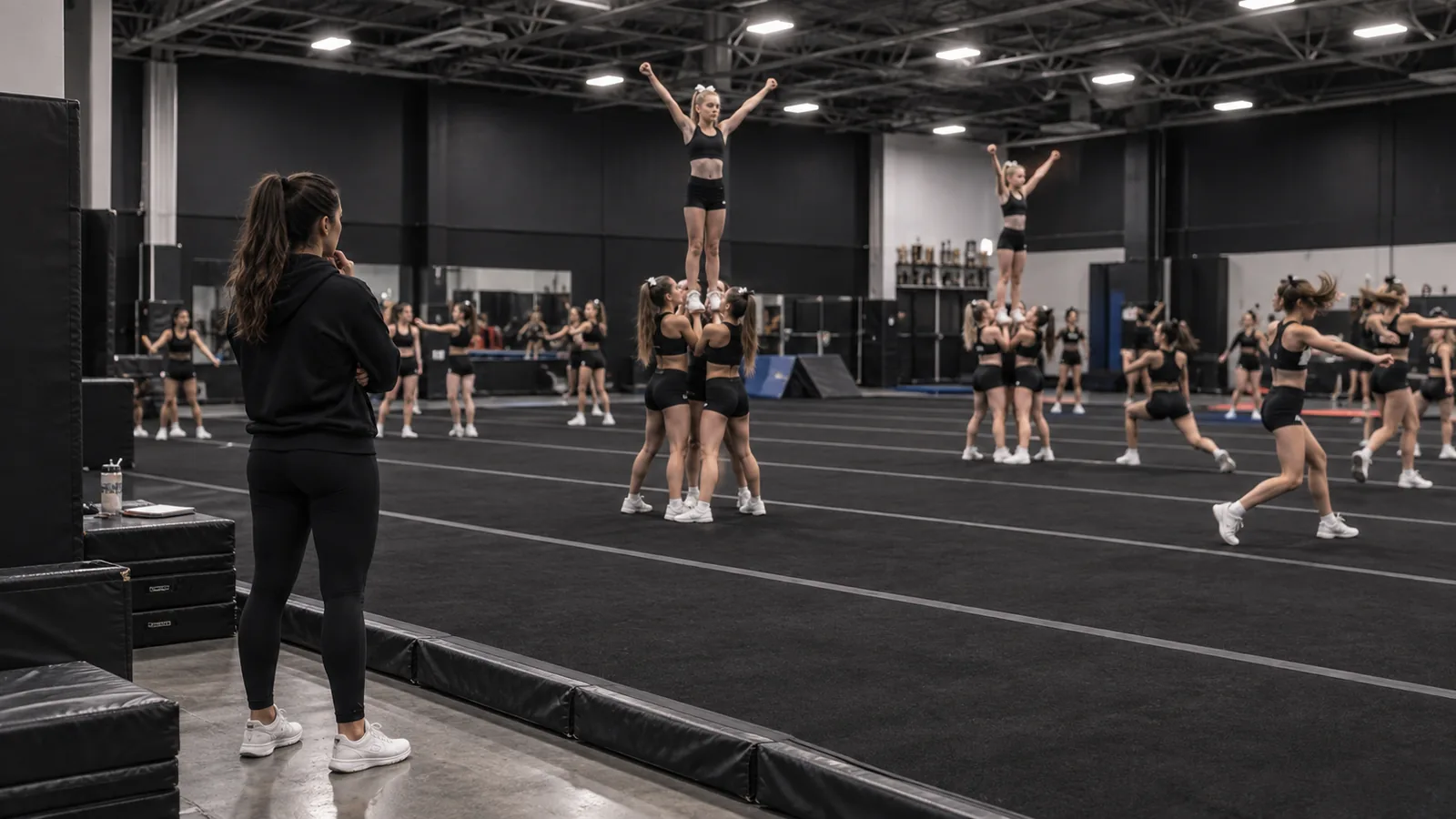
Two cheer teams can perform routines with similar skills and still look very different on the competition floor.
One team may appear controlled, synchronized, confident, and easy to follow. The other may complete most of the same skills but show small timing differences, inconsistent body positions, rushed transitions, or hesitation between sections.
Difficulty is important, but it is only one part of how a routine is evaluated.
Completing a skill and performing it well are not the same thing.
Scoring systems vary between organizations and events, so coaches should always work from the criteria that apply to their team.
If your team is competing regularly in December, this is a good time to look beyond the skill list and examine the details that affect how the entire routine presents.
Difficulty Tells Only Part of the Story
It is easy to compare routines by looking at the biggest skills.
- Which team has the harder stunt?
- Who has the more difficult tumbling?
- Which pyramid appears more complex?
Those comparisons can be useful, but they do not tell you everything about the routine.
Imagine two teams performing similar stunt sequences.
Team A
Controlled body positions, consistent timing, and very little visible adjustment.
Team B
Completes the same sequence, but groups move at different times and make visible corrections.
On Paper
The content may appear almost identical.
On the Floor
The overall presentation can look completely different.
Evaluate both what athletes are performing and how consistently they are performing it.
Execution Is More Than Whether the Skill Hits
A skill can technically be completed and still have several details that need attention.
When reviewing practice or competition video, avoid using only two categories:
Hit.
Miss.
Look deeper.
- Were body positions controlled?
- Were athletes making visible corrections?
- Did the skill finish cleanly before the next movement began?
- Did every group perform the skill the same way?
- Was technique maintained from beginning to end?
Small errors may not feel significant individually. Across multiple stunt groups, passes, formations, and transitions, however, those details can change the overall quality of the routine.
Try watching one section three different times.
Viewing 1
Watch only whether the skills are completed.
Viewing 2
Watch technique, body positions, and control.
Viewing 3
Watch what athletes do immediately before and after the skill.
Compare
Look for repeated details that are affecting the section as a whole.
Timing and Synchronization Change How the Whole Routine Looks
A team does not need to make a major mistake for timing issues to become visible.
Sometimes the difference is only a fraction of a count.
- One stunt group dips before the others.
- One athlete begins choreography early.
- Tumbling passes start at slightly different moments.
- A formation reaches its final picture in stages instead of all at once.
When these differences happen repeatedly, the routine can feel less unified.
Clean the Start and Finish of Every Action
Coaches often focus on the middle of the skill.
Also check the edges.
- When does the movement begin?
- When should it finish?
- When should athletes be completely set for what happens next?
For example, if four stunt groups perform the same sequence, freeze the video at the initiation, the main body position, and the finish.
Are the groups creating the same picture at the same time?
If not, you now have a specific timing issue to coach instead of simply telling athletes to “be more synchronized.”
Use Counts More Precisely
“Do it together” is not always enough information.
Give athletes a clear timing target.
- Which count initiates the movement?
- Where should the body position be established?
- On what count does the transition begin?
Specific counts make synchronization easier to repeat.
Performance Quality Should Continue Between Skills
Performance is not something athletes turn on only during dance or choreography sections.
Watch what happens immediately after major skills.
- Do faces and energy disappear while athletes travel?
- Do arms drop as athletes move into the next formation?
- Does the team look confident during one section and hesitant during another?
Athletes can know every count and still look unsure if they are thinking through the routine instead of performing it.
Coaches can improve this by assigning performance expectations just as specifically as technical ones.
Instead of
“Perform more.”
Try
“Keep your eyes up throughout this transition.”
Try
“Finish this motion before you travel.”
Try
“Do not let the energy drop after tumbling.”
Those instructions give athletes something concrete to repeat.
Do Not Ignore What Happens Between Major Skills
Transitions are often where routines lose visual clarity.
Coaches naturally spend significant practice time on stunts, tumbling, pyramids, and jumps. But an audience sees the entire routine—including every step athletes take between those elements.
A team can complete a strong skill and immediately look disorganized because athletes are crossing through one another, taking different pathways, or arriving at the next formation at different times.
Check Pathways, Not Just Final Spots
Do not only ask whether athletes eventually reach the correct formation.
Watch how they get there.
- Are two athletes competing for the same pathway?
- Is someone taking a longer route than necessary?
- Does an athlete have to speed up during the final counts?
- Does the formation look scattered before suddenly snapping into place?
The route matters.
A clean transition should feel intentional from beginning to end.
Give Athletes Their Own References
Athletes should not rely entirely on following teammates.
- Who is your opposite?
- What line are you using?
- Where should you be halfway through the transition?
- How many steps should this take?
Clear landmarks and individual responsibilities make formations more repeatable.
Consistency Matters More Than the Best Rep You Have Seen
One of the hardest things for coaches is separating what a team can do from what the team can repeat.
You may have seen a stunt section look incredible in practice.
But how often?
- Once out of ten reps?
- Seven out of ten?
- Can athletes perform it at the end of a full routine?
- Can they repeat it when tired?
Competition decisions should be based on the version of the routine your athletes can reliably perform—not only their best-ever rep.
Instead of only asking, “Did they hit?” record several reps.
Rep 1
Completed, timing uneven.
Rep 2
Completed, one visible adjustment.
Rep 3
Clean.
Rep 4–5
One miss and one completed rep with technique changing late.
That gives you a more realistic picture of consistency.
How to Decide Whether to Upgrade or Clean
When teams see competitors performing similar or greater difficulty, the instinct may be to add more.
Before changing the routine, ask four questions.
1. Consistency
Is the current version stable enough to build on?
2. Feedback
What are the scoresheet and scoring criteria actually telling you?
3. Disruption
What entries, transitions, formations, or responsibilities will change?
4. Time
Do you have enough quality practices to train the upgrade properly?
An upgrade that looks promising in isolated practice may not yet be ready for the routine.
If you have already identified a section that needs hands-on routine or choreography work, B leJit’s Virtual Enhancement Session provides virtual coaching that can include choreography and routine improvements.
Explore the Virtual Enhancement Session →
Use Your Scoresheet and Video Together
Competition footage becomes more useful when you review it alongside your scoresheet.
Start by reading the feedback.
Then find the corresponding section on video.
- Can I see the issue being described?
- Is it happening with one athlete or several?
- Does the problem appear once or throughout the routine?
- Is the visible problem actually caused by something earlier?
For example, an athlete arriving late to a formation may look like a spacing problem.
After reviewing the video, you may discover the athlete is forced to take a longer pathway because of the transition before it.
The spacing is the symptom.
The pathway is the cause.
If you are seeing execution issues in competition but are unsure which ones deserve priority, B leJit’s Score Audit / Score Sheet Review is designed around reviewing a completed competition performance and its score information.
Learn More About Score Audit / Score Sheet Review →
A Simple Execution Framework: Control, Timing, Presentation, Connection, Repeatability
Use these five categories when reviewing your routine.
Are skills performed with consistent technique and body positions?
Are athletes initiating and finishing movements together?
Do athletes maintain confidence, energy, and commitment?
Are transitions, pathways, and formations intentional?
Can the team reproduce the routine consistently?
When a section feels “off” but you cannot immediately identify why, evaluate it through these five categories.
Execution and Consistency Checklist
Before adding difficulty, check:
When You Need Help Deciding What Deserves Attention
Once competition season is underway, the challenge is often not finding things to fix.
It is deciding which details deserve your practice time first.
If you have a recent competition video and score information and want another experienced perspective on what to focus on next, B leJit’s Score Audit / Score Sheet Review can help you evaluate the performance and turn the feedback into a clearer next step.
Win the Details Before Chasing More Difficulty
When two teams have similar skills, the difference is often found in everything surrounding those skills.
- Control
- Timing
- Synchronization
- Performance
- Transitions
- Spacing
- Consistency
That is why the answer to every competitive challenge cannot simply be “make the routine harder.”
Sometimes an upgrade is appropriate.
Sometimes a choreography adjustment is needed.
And sometimes the best use of practice is making the routine athletes already have more controlled, unified, and repeatable.
Study your scoresheet. Watch the video carefully. Look for patterns. Decide which details are creating the biggest problems.
Then build practice around those details.