


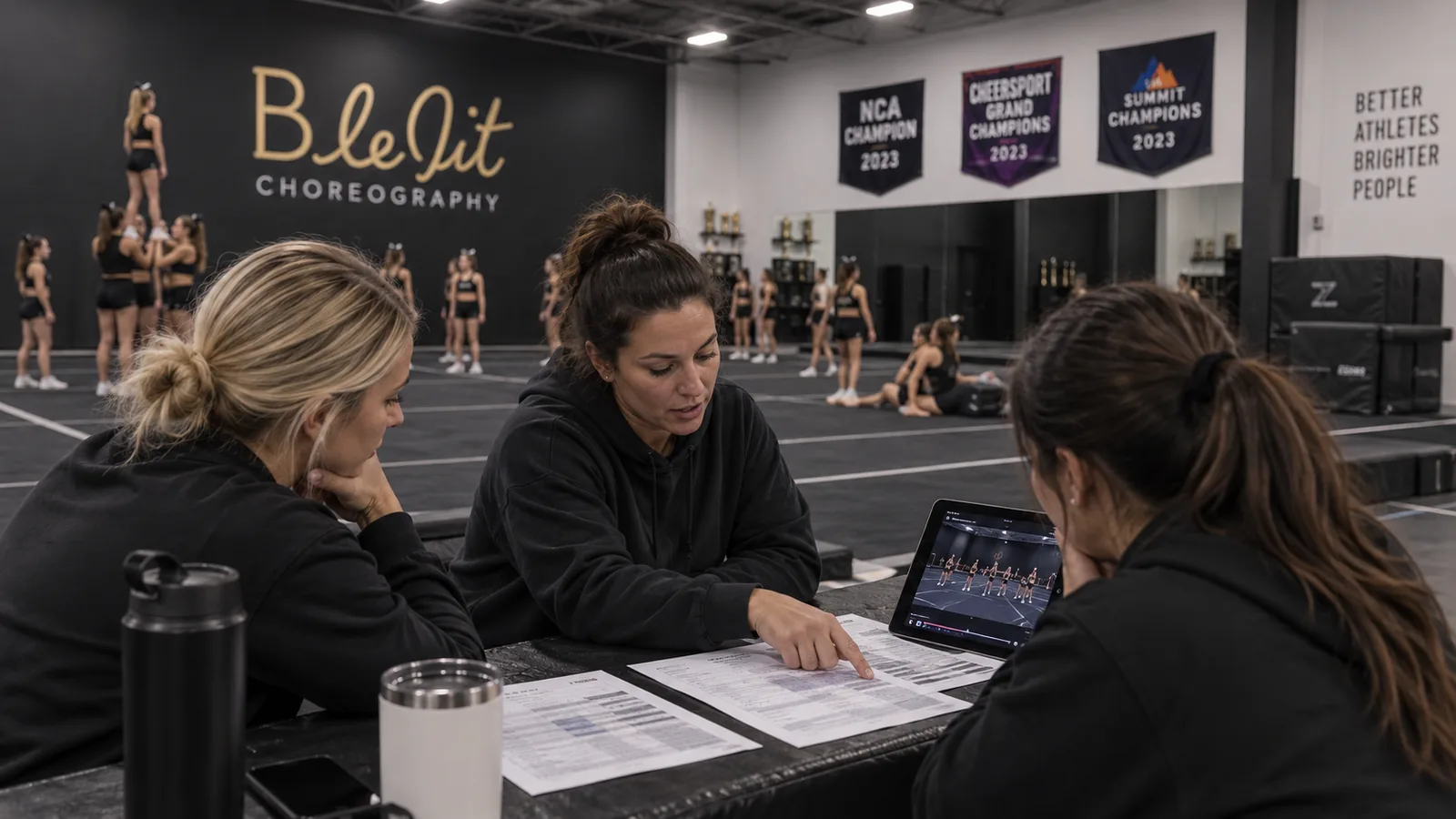
The first competition of the season gives coaches something practice cannot: outside feedback on how the routine is presenting in a competitive setting.
When the scoresheet arrives, it is easy to jump straight to the total score.
But that number is only one piece of the information in front of you.
Comments, section scores, rankings, execution trends, and repeated feedback can help you decide what deserves attention at the next practice.
The goal is not to react to every number or rebuild the routine after one competition. It is to turn the first scoresheet into a practical plan.
Scoring systems vary, so always evaluate feedback within the rules and score structure your team actually competes under. But regardless of the system, the same coaching principle applies: look for patterns before making changes.
Start With the Scoresheet, Not Just the Score
The total score tells you where the team landed that day.
It does not automatically tell you what to do next.
Instead of looking at the final number first and working backward emotionally, review the scoresheet section by section.
- What areas were strongest?
- Where was there a noticeable drop?
- What comments appeared more than once?
- Are the comments consistent with what we saw on video?
- Did multiple pieces of feedback point toward the same problem?
A lower-than-expected total can come from several smaller issues rather than one major problem.
Likewise, one weak section does not necessarily mean the entire routine needs to change.
Your first job is diagnosis, not correction.
Separate the Feedback Into Categories
A useful way to make a scoresheet less overwhelming is to organize the feedback before deciding what to fix.
Try sorting your notes into four categories.
1. Execution
Look at how athletes are performing what is already in the routine.
This may include synchronization, timing, body positions, technique, spacing, or consistency.
2. Routine Structure
Consider whether the issue is how the section is built rather than only how athletes are performing it.
Transitions, formations, entries, and choreography may need attention.
3. Difficulty
Evaluate whether the current level of difficulty matches the team’s ability to execute it consistently.
4. Performance
Look at clarity, energy, confidence, timing, and whether athletes continue performing between major skills.
Execution
Execution issues relate to how athletes are performing what is already in the routine.
Examples might include synchronization, timing, body positions, technique, spacing, or consistency.
If the routine concept is working but athletes are not performing it consistently yet, the answer may be more focused cleaning rather than new choreography.
Routine Structure or Choreography
Some feedback may point toward the way a section is built rather than simply how athletes perform it.
- A transition may feel rushed.
- A formation may not read as clearly as it did in practice.
- Athletes may be using too much energy getting into position before a skill.
These issues require a different coaching response than simply telling athletes to “hit harder.”
If the feedback suggests that a section itself needs to be adjusted, B leJit’s Virtual Enhancement Session can provide live virtual coaching for routine and choreography improvements.
Explore the Virtual Enhancement Session →
Difficulty
Difficulty and execution need to be evaluated together.
A coach may see a lower section score and immediately think:
“We need to upgrade.”
Maybe. But first ask whether the existing difficulty is actually being performed consistently.
If athletes already have appropriate content but are struggling to execute it cleanly, adding another challenge may make the section harder to stabilize.
On the other hand, if execution is consistent and the scoresheet repeatedly suggests that a section has room to develop, then an upgrade may be worth exploring.
Do not treat difficulty as an automatic solution to every scoring issue.
Performance and Presentation
Sometimes the technical pieces are present, but the section does not have the clarity, energy, timing, or confidence you expected.
This is where competition video becomes important.
Compare what the scoresheet says with what you actually see.
- Are athletes finishing movements?
- Does the team maintain energy between major skills?
- Do formations read clearly from the front?
- Are athletes performing throughout transitions?
- Does the routine visually drop between sections?
The scoresheet gives you feedback. Video helps you understand the context.
Look for Repeated Feedback Before You React
One comment deserves attention.
A pattern deserves priority.
If several pieces of feedback point toward timing, that is more useful than one isolated comment about a single moment.
The same is true across competitions.
Keep a simple running list of repeated themes.
Competition 1
Timing mentioned in pyramid.
Spacing mentioned in dance.
Stunt execution strong.
Competition 2
Timing mentioned again.
Spacing improved.
Performance quality mentioned.
What Improved?
Spacing appears to be responding to the work already being done.
What Needs Priority?
Timing has become a repeated issue and should receive more attention.
This prevents the team from changing direction every time a new scoresheet arrives.
Compare Judge Feedback With Your Competition Video
Do not review the scoresheet in isolation.
Watch the performance again with the feedback in front of you.
When a comment identifies a problem, find that section on video.
- Can I see what the feedback is referring to?
- Is this happening with one athlete or the whole team?
- Is it a one-time mistake or something we also see in practice?
- Does the problem begin earlier than the moment the comment identifies?
For example, a formation may look off when athletes arrive, but the real problem may be a transition that forces two athletes into the same pathway.
A stunt may appear rushed, but the cause may be the timing coming out of the section before it.
Finding the cause is more useful than correcting only the visible symptom.
Decide Whether to Clean, Change, or Stay the Course
After reviewing the scoresheet and video, every issue should lead to one of three decisions.
Clean It
Choose cleaning when the routine concept is working but execution is inconsistent.
Change It
Make a change when there is a clear reason the current version is not working as intended.
Keep It
Stay the course when a section is improving and the issue is already being addressed through cleaning.
Ask Why
Do not change something simply because you feel like you have to do something after competition.
Clean It
Choose cleaning when the routine concept is working but execution is inconsistent.
That could mean focusing on timing, technique, spacing, synchronization, transitions, or performance quality.
Change It
Make a change when there is a clear reason the current version is not working as intended and the team has enough time to learn the adjustment.
A change does not have to be major.
- Move an athlete’s pathway.
- Adjust a count.
- Simplify an entry.
- Change a formation.
Small changes may solve the issue without rebuilding an entire section.
Keep It
This is the option coaches sometimes overlook.
Not every piece of feedback requires a change.
If a section is improving, athletes are becoming more confident, and the issue is already being addressed through cleaning, staying the course may be the smarter decision.
Avoid changing something simply because you feel like you have to “do something” after competition.
Use the Impact-Effort Test Before Making Changes
When several things need attention, prioritize the changes that can create the most useful improvement without unnecessarily disrupting the routine.
Use two questions:
How much impact could fixing this have?
How much practice time and disruption will it require?
High Impact, Low Disruption
Start here when possible.
Examples may include timing fixes, spacing corrections, performance adjustments, or small choreography changes.
High Impact, High Disruption
These may still be worthwhile, but make sure you have enough practice time before the next competition.
Low Impact, Low Disruption
Make these improvements when they fit naturally into practice without distracting from higher priorities.
Low Impact, High Disruption
Be cautious.
A large rebuild may not be worthwhile for a relatively minor issue.
Do Not Try to Fix the Whole Scoresheet in One Practice
A common mistake after the first competition is walking into practice with a long list of corrections and trying to address all of them immediately.
That usually spreads attention too thin.
Choose two or three priorities.
Priority 1
Clean stunt timing.
Priority 2
Fix spacing in two transitions.
Priority 3
Improve performance through the dance.
Next Layer
Once those areas improve, move to the next group of priorities.
The scoresheet should help organize practice, not overload it.
A Simple Scoresheet Review Framework: Read, Compare, Prioritize, Test
Use this four-step process after an early competition.
1. Read
Review the entire scoresheet before focusing on one number or comment.
2. Compare
Match the feedback to competition video and what you have been seeing in practice.
3. Prioritize
Identify the two or three repeated issues that deserve the most attention.
4. Test
Make the correction in practice and see whether it actually improves the section before committing to a larger change.
If you make meaningful adjustments and want another experienced perspective on how the updated routine is coming together before the next event, B leJit’s Cheer Routine Review lets coaches submit a routine video for professional feedback before competition.
Learn More About Cheer Routine Review →
First Scoresheet Review Checklist
Before changing the routine, ask:
When You Need Help Turning Feedback Into a Plan
Receiving feedback is one thing.
Deciding what to do with it is another.
If your first scoresheet has left you with questions about what to change, what to keep, or how to work through specific routine improvements, B leJit’s Virtual Enhancement Session provides live virtual coaching for cheer coaches and teams working on routine and choreography needs.
Your First Scoresheet Is a Starting Point
Your first scoresheet is not the final verdict on your season.
It is information.
Use it to identify patterns, confirm what you are already seeing in practice, and determine where your time can be used most effectively.
- Some feedback will require cleaning.
- Some may lead to a small routine adjustment.
- Some may tell you that the team simply needs more repetitions and confidence.
The important thing is not to react to every comment independently.
Read the feedback. Compare it with video. Look for patterns. Prioritize the changes that matter most. Then give those changes enough time to work.
A scoresheet becomes valuable when it changes what you do next.